Showing posts with label Leaves. Show all posts

Sunday, July 10, 2016

Rhubarb: No Rue and No Barb!

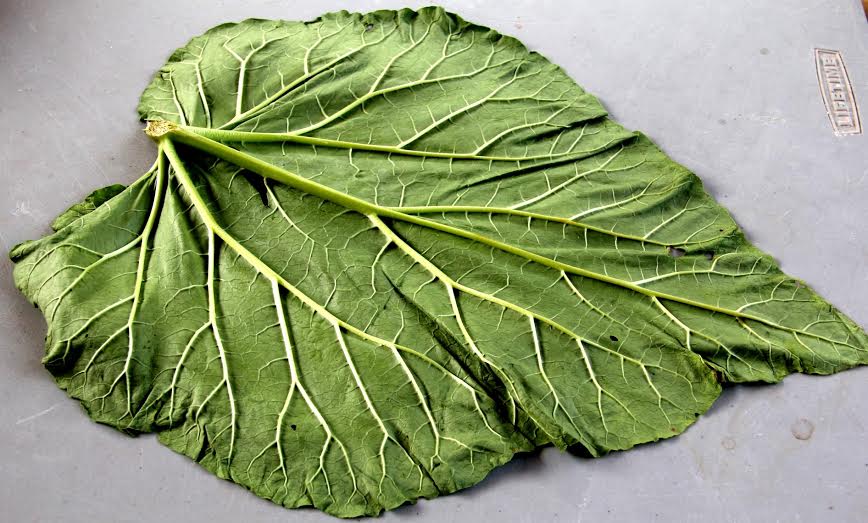
Here’s to the lowly rhubarb leaf! My octogenarian friend Ken called to ask if I’d like some more rhubarb. He was harvesting his patch and I happily said, “Yes! And please bring the leaves too!” Ken responded with a shocked, “No, they are poisonous!” Having been an extension agent for something like forty years, he knows what he is talking about. I explained that I use them on my pots, not in them. They have lovely veining—not as fine as that of the even-more-lowly burdock, but impressively dramatic and strong. Ken arrived on his 4-wheeler with an armload of magnificent rhubarb stalks with all their leaves.

Due to the thick center stalk in a rhubarb leaf, using the leaf as it grows can cut right through the clay when I lay it out. Hence, I trim that thick area down level with the rest of leaf with sharp scissors or a knife. This gets easier with practice and I go through enough burdock and rhubarb leaves in their season to have plenty of that. Then the leaf is laid on wet, rolled-out clay and I cut around it. (I never went to kindergarten and have been making up for that ever since.) Next the leaves are dropped inside a large, plastic-draped, aluminum bowl of a pleasant shape. I make sure the bottoms of the leaves are well smoothed (read that as “smooshed”) together and the upper leaves each free to show itself off. Two or three days later, I left the whole thing out of the bowl, clean all the many edges, and set it on the racks to dry. Those leaves are majestic! If I knew where to put it, I might keep one of these big pots!

Monday, November 16, 2015

Those Ravishing Radishes


Jim Randall, (Elk Run Farm) a long-time farmer in the Shenandoah Valley, brings his produce to the market in Harrisonburg on Tuesdays. For several years I have availed myself of those lush goods, as well as plied Jim with questions about local farming ways. Lately, a series of different types of radishes have appeared on Jim’s stand. I am not an ardent devotee of radishes, although I like the Japanese daikon. My husband is the radish eater in our home, while I get excited about their leaves. Folks at the Farmers Market sometimes think it is strange to buy vegetables for their leaves, but a sale is a sale. And who can pass up such gorgeous foliage after the first frost when good greenery is hard to find?


I’ve made five bowls recently with a variety of leaves from German radishes (lovely globes that do not split, no matter how large they get), some other type of radish that comes in a plethora of beautiful reds and purples, a couple daikon-- and a bunch of parsnips. By all accounts, the radishes were delicious. I know the daikon was great in the wontons I took to the recent reception at the co-op. Parsnips I love in any form, but the leaves are best on bowls. Those landed on pumpkin pots. That is, I pressed the leaves into circles on rolled out clay, cut out the clay around their outside edge, and then pressed the clay down over those wonderfully organic pumpkins with the big ridges. The bowls are not as round as they might be when made over other pots, but their shape speaks to the land, the market, and the kitchen. The first “ravishing radish pot” I made was purchased as a gift for a chef. I have others now that will make a great holiday gift for the cook in someone’s life. And I have one to take to Jim, so he will finally understand why I ooh and ahh over his leaves.

Wednesday, June 17, 2015

Those Lovely Great Big Leaves!


I was working at OASIS Fine Art & Craft in Harrisonburg last week when Brenda Fairweather (of Hot Flash Pottery and D’vine Baskets fame) walked in with a long tubular newspaper roll in her arms. She presented it to me with a flourish and there they were-- a whole collection of huge rhubarb leaves. It’s the rhubarb stems we eat; the leaves are allegedly poisonous. I’ve never been tempted to eat them, for sure, but I know what to do with them on the clay! What a thoughtful gift! 

Having spent my youth alternating hot summer days between weeding a vegetable garden and throwing heavy hay bales onto a wagon, as an adult I have been steadfastly committed to avoiding such toil. Lo and behold, Bill gets stationed in Germany and we discover that our 1830s house has a designated plot in the community garden. Once I learned that my neighbors didn’t think Americans know how to make gardens, of course I had to prove them wrong. But back in the US, I quickly reverted to my delightful get-our-veggies-at-the-farmers’-market strategy and planted flowers. 

Then we moved to West Virginia where there seems to be no end of space and I could not help designing a few containers for perennial eatables. Bill built them—sturdy and ready. Two for asparagus (someday I’ll tell you that story), one for gooseberries (because the name makes me want to sing limericks and reminds me of some old friends of my mother’s), and a big one for rhubarb. This turned out to be an exercise in patience because only the berries can be used the first year. The pencil-thin asparagus and flourishing rhubarb plants need to grow for one more year, after which I am promised they will be plump and hearty. Knowing  how hard it is for me ignore those huge rhubarb leaves waving in the breeze back there and looking like they would love to shape and decorate pots, Brenda arrived with her cylinder of leaves! Now that’s a real gift!


Monday, June 1, 2015

Leaf Junky Celebrations


I wait impatiently for leaves to appear in the spring. Then I marvel at how prolifically they do that, while I fuss because the leaves are not yet large enough to impress me with their impressions on my clay! Soon they abound and, with abandon, I harvest leaves until fall. I prefer large ones with lots of pronounced veins. The real sign of my craving for natural foliage is that I dread the threat of running out of leaves. Every autumn I collect (some types before a frost, some after) all shapes and sizes of leaves and tuck them into old magazines, catalogs and newspapers, depending on the size of my quarry. I use an old drafting board I found in my father’s basement to weight the bursting tomes, making sure that the outside edges are open to the air. In no way does this compare with the hay mows we spent much of summer filling in my youth, but the outcome is the same. That corner of the studio’s drying room keeps me supplied with dry flat leaves for making pots all winter.

Now spring is well sprung and all manner of vegetation is back with gusto. Some folks are out looking for ramps or morel mushrooms, while I stalk especially large, fine-veined leaves. A primary source is the reviled burdock, for which I have absolutely no competition. Burdock leaves are big and leathery now, and the bugs have not got to them yet.  I use their bottom sides, where the veins are more strongly defined. I often have to cut out the center stem, because it is so thick that it will cut through the clay when I roll the leaf and clay together. Having become far more observant of leaf properties than I once was, I see that the size of a leaf and the intricacy of its veining often do not correlate, although some plants that grow very rapidly have surprisingly few veins, while other large leaves have incredible webs and tangles of veins that leave great trails in clay.

A pumpkin or a big metal bowl for form, a bunch of leaves, and a few pounds of clay—that’s what pots are made of! I love using light buff clay with my leaves. When the pots are dried, have been bisque fired, and are ready to glaze, I brush on a black undercoat and then wash most of it off. What’s left emphasizes those leafy tracks that I so admire. Then I put a clear glaze over the entire outside. Anything goes on the inside of pots: reds, greens, blues, yellow, or maybe mottled spice brown—or combinations. I owe those leaves, so I wait to see what they suggest.